Anders Hesselbom
Programmerare, skeptiker, sekulärhumanist, antirasist.
Författare till bok om C64 och senbliven lantis.
Röstar pirat.
Parse Transact SQL
2016-01-07
To parse T-SQL from C#, add a reference to the following libraries (listed under Extensions, not under Framework):
Microsoft.Data.Schema.ScriptDom
Microsoft.Data.Schema.ScriptDom.Sql
My examples imports the following namespaces:
using System;
using System.Collections.Generic;
using System.Linq;
using Microsoft.Data.Schema.ScriptDom;
using Microsoft.Data.Schema.ScriptDom.Sql;
using System.IO;
This code shows how to parse a boolean expression:
//Parse
var p = new TSql100Parser(false);
IList<ParseError> err;
var sql = "(a > 10) and (i < 10)";
var exp = p.ParseBooleanExpression(new StringReader(sql), out err);

//Errors? Empty if none.
Console.WriteLine($"{err.Count} errors.");
err.ToList().ForEach(x =>
   Console.WriteLine(
      $"Error \"{x.Message}\" at line {x.Line}."));

//Result. Null if errors.
if (!(exp == null))
   exp.ScriptTokenStream.ToList().ForEach(x =>
      Console.WriteLine(
         $"Token type: {x.TokenType}, source: {x.Text}"));
If you want to parse a complete Transact SQL program, call the ParseStatementList function instead of the ParseBooleanExpression function.
//Parse
var p = new TSql100Parser(false);
IList<ParseError> err;
var sql = "SELECT EmployeeID, FirstName FROM dbo.Employees WHERE FirstName LIKE 'N%'";
var exp = p.ParseStatementList(new StringReader(sql), out err);

Console.WriteLine($"{err.Count} errors.");
err.ToList().ForEach(x =>
   Console.WriteLine(
      $"Error \"{x.Message}\" at line {x.Line}."));

//Result. Null if errors.
if (!(exp == null))
   exp.ScriptTokenStream.ToList().ForEach(x =>
      Console.WriteLine(
         $"Token type: {x.TokenType}, source: {x.Text}"));
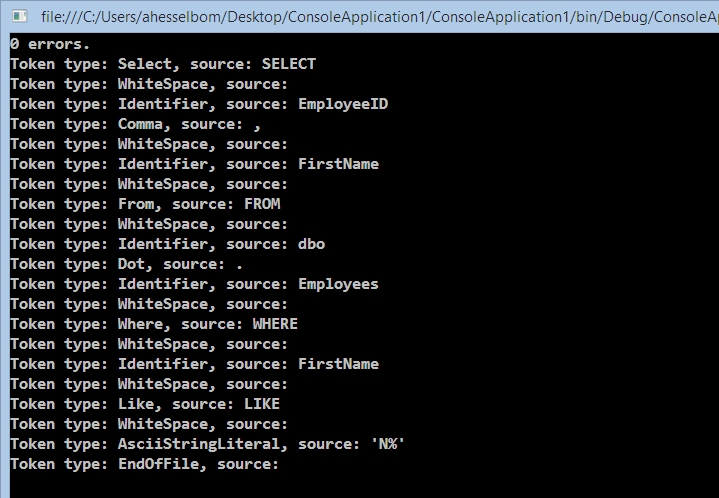
This is the expected output:
Categories: C#
En kopp kaffe!
Bjud mig på en kopp kaffe (20:-) som tack för bra innehåll!


Följ mig

|

|

|

|

Leave a Reply