Anders Hesselbom
Programmerare, skeptiker, sekulärhumanist, antirasist.
Författare till bok om C64 och senbliven lantis.
Röstar pirat.
Environment variables
2011-02-13
Assuming that you are running Windows 7, the environment variables can be manually accessed if you right click on Computer, and select Properties. From there, you click Advanced system settings and on the Advanced tab, you click the Environment variables button. You can check your current variables, edit them and add new variables.
I am running a Swedish installation of Windows 7.
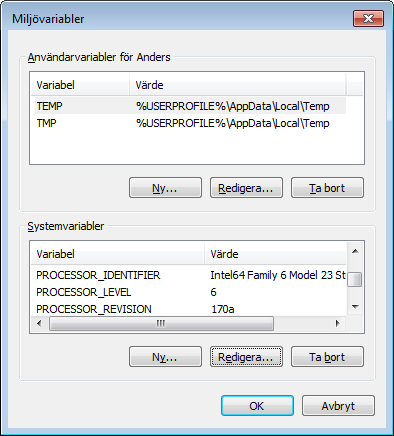
To read them from Visual Basic, you just use the GetEnvironmentVariables function to retrieve the collection of registered variables. This example is written in VBx (Visual Basic 10):
Console.WriteLine(
   Environment.GetEnvironmentVariables().
      Item("PROCESSOR_REVISION").ToString())
Remember, when you write code to manipulate this collection, adding or changing values, you would normally want your code to run as a custom step in an MSI file, and not in a regular EXE.
Categories: VB.NET
En kopp kaffe!
Bjud mig på en kopp kaffe (20:-) som tack för bra innehåll!


Följ mig

|

|

|

|

Leave a Reply